
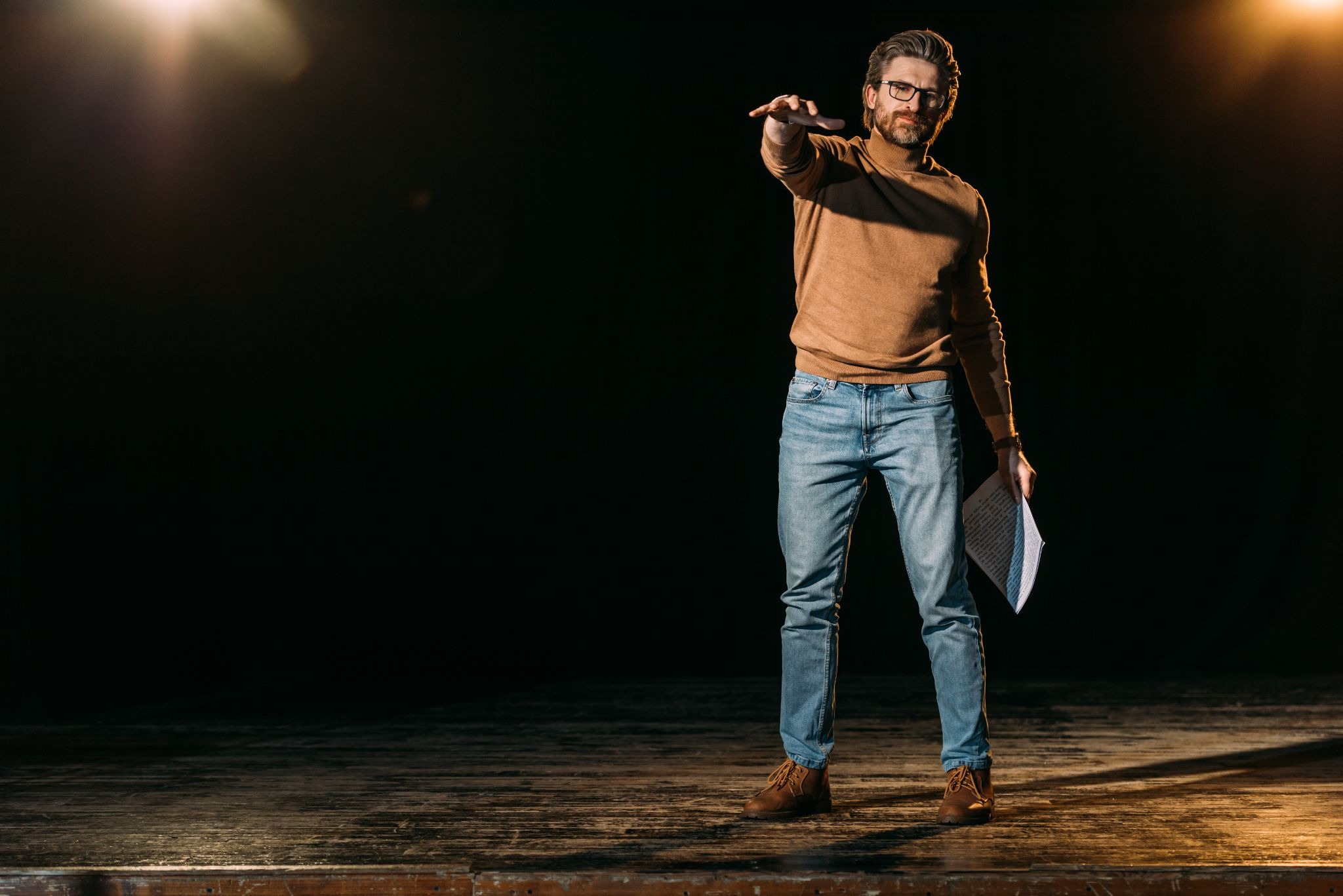
There is a performer who walks onto the stage and immediately the room shifts. No one can explain exactly why. They have not spoken yet. The lighting has not changed. But something happens in the audience, a collective leaning forward, a quieting, an attention that snaps into focus the way it does when something genuinely important is about to occur. That performer has stage presence. And while stage presence is sometimes spoken about as though it is a mystical quality distributed at birth to the fortunate few, the truth is more interesting and more democratic than that. Stage presence is largely physical. It is built in the body. It lives in the way a performer inhabits space, moves through it, uses stillness within it and communicates with an audience before a single word is spoken. Body language in acting is not a supplementary skill that improves a performance at the margins. It is the primary instrument through which an actor communicates to every person in every seat, including the ones too far away to see facial expressions or hear nuanced vocal delivery. This guide explores how body language creates, sustains and elevates stage presence with the depth and specificity that performers actually need.
The Body as the Primary Instrument of Stage Communication
Acting training often focuses heavily on voice and text. Vocal production, breath support, diction, verse speaking and character voice are central to most conservatory curricula. And they matter enormously. But the body communicates faster, more broadly and often more honestly than the voice. A trained audience member watching a performance with the sound turned off can frequently follow the emotional arc of a well-performed scene simply through physical storytelling. And the audience member in the back row of a large theatre, for whom every nuance of facial expression and vocal subtext is beyond perceptual reach, is entirely dependent on physical storytelling for their engagement.
Posture and Physical Alignment: The Architecture of Character
Every character has a physical architecture. A way of organizing the body in space that reflects the character’s psychology, social position, emotional history and relationship to the world. This physical architecture, established through the performer’s postural choices, is the most immediate and persistent physical signal the audience receives throughout the performance. It is always present, even in stillness, and it communicates constantly even when the character is not speaking.
The Spine as the Emotional Spine of Performance
The spine deserves particular attention because it is the structural core from which all postural and movement choices radiate, and because spinal alignment has direct effects on vocal production that connect body language and vocal performance in a single integrated system. A fully extended, properly aligned spine creates the maximum internal volume for diaphragmatic breath support, enabling the full vocal range and projection capacity that stage performance demands. A collapsed or misaligned spine compresses the diaphragm and limits breath capacity, directly reducing vocal power and range.
Gesture: Intention, Specificity and the Danger of Illustration
Gesture in acting is the area where the gap between amateur and professional performance is most immediately visible, and it is the area where misunderstanding is most common. The most frequent gestural problem in inexperienced performers is illustration: the use of gestures that draw pictures of the words being spoken rather than expressing the psychological reality beneath the words. A performer who gestures upward on the word “sky,” makes a large sweeping gesture on the word “vast” or points at another character every time their character is mentioned is illustrating rather than embodying. These illustrative gestures read as mechanical and false to audiences because they are disconnected from genuine impulse.
Effective gesture in acting grows from genuine physical impulse rooted in the character’s psychological reality. When a character speaks from a place of real urgency, need or feeling, the body finds its own gestural expression of that state without conscious direction. The actor’s job is not to choreograph gestures onto the text but to create the genuine interior conditions from which authentic gesture spontaneously arises. Stanislavski’s concept of physical action, later developed and extended by Sanford Meisner and other acting theorists, points consistently toward this inside-out approach: generate the genuine psychological reality and allow the body to find its own expression of that reality.
Specificity Versus Generality in Physical Expression
The most powerful physical expression in acting is specific rather than general. General gestures, large sweeping movements that express a broad emotional category, read as acting from the back of the house and actually communicate less than specific, particular physical choices that express something precise about this character in this moment. A character who is terrified does not simply manifest generalized fear posture. They manifest the specific way that this particular person’s terror inhabits their body, perhaps a very still quality in the legs combined with hands that grip and release repeatedly, perhaps a quality of controlled breathing that is barely holding panic at bay, perhaps a very particular way of orienting the body toward potential exits.
Movement Through Space: Status, Relationship and Dramatic Structure
How a performer moves through the stage space is as communicative as how they hold their body in stillness. The paths characters take through space, the pace and quality of their movement, their spatial relationship to other characters and to the environment, all communicate continuously to the audience and contribute to the emotional and dramatic information the performance is delivering.
The relationship between movement and dramatic text is one of the most sophisticated areas of physical acting craft. Movement that happens on speech, by which directors mean movement initiated at the beginning of a line or phrase, tends to diminish the impact of both the movement and the text because the audience’s attention is divided between processing the physical and the verbal simultaneously. Movement that happens between speeches, in response to what has just been heard or in preparation for what is about to be said, typically creates more dramatic impact because it allows the audience to complete their processing of the verbal information before the physical information demands attention, and because it visually demonstrates the impact of the dialogue on the character’s behavior.
Eye Focus and the Architecture of Connection
Where a performer directs their gaze is one of the most powerful and least consciously observed aspects of physical performance. The eyes lead the attention of both the character and the audience. When a performer looks at something, the audience looks at it too. When a performer’s eyes are unfocused or directed at an indeterminate point in the middle distance, the audience has no external anchor for their attention and the performer’s interior life, whatever it may be, fails to communicate outward.
The relationship between eye focus and thought is fundamental to effective acting. Genuine thought produces genuine eye movement. The eyes of a person who is actually thinking about something, actually hearing something for the first time, actually deciding something, move with specific, task-related patterns that are immediately readable to observers as signs of genuine cognitive activity. Eyes that are fixed in position while the performer delivers text communicate not thought but memorization, and audiences recognize the difference even if they cannot articulate it.
Breath as the Foundation of Physical Presence
The relationship between breath and physical presence is understood by every advanced acting teacher and consistently underestimated by students. Breath is not simply a voice production mechanism. It is the physiological foundation of authentic emotional response and physical presence. The way a character breathes tells the audience about their emotional state, their physical condition, their relationship to what is happening in the scene and their fundamental orientation to their world.
Performers who are holding their breath, as many nervous performers do without awareness, communicate tension and constraint to the audience through the physical stillness of a chest that is not moving. This tension is visible from a considerable distance and creates a physical disconnection between the performer and the character they are attempting to inhabit. The released, natural breath of a performer who is genuinely present in their body creates a visible quality of aliveness that is one of the defining characteristics of compelling stage presence.
Final Thoughts
Every lie an actor tells in performance, and acting is of course the art of truthful lying, must be told with the whole body or it will not be believed. The voice can maintain a fictional front that the body quietly dismantles. The words can claim courage that the spine quietly refutes. The text can assert love that the hands quietly deny. But when the body is fully engaged in the physical reality of the character’s experience, when it has been genuinely trained to be available, responsive and specific in its expression, it tells the most powerful truth available in live performance: the truth of one human being, shaped by imagination and craft into another, standing in the full exposure of the stage and making an audience feel something real. That is what body language in acting makes possible. And it is worth every hour of practice it demands.